

Gods and Demons expands across Google Play, App Store and Huawei AppGallery as cross-play title
Key takeaways
- Gods and Demons is publishing on Google Play, App Store and Huawei AppGallery.
- Closed beta: 1,421 new character creations and day‑one retention of 41.93%.
- Standard daily tasks under 30 minutes; individual battles last ~3–5 minutes.
- Moye’s core team has 11 developers and used AppGallery Connect for crash analysis and remote debugging.
Moye Interactive Entertainment has begun rolling out Gods and Demons as a cross-play title across multiple app stores, including Google Play, the App Store and Huawei AppGallery, and is using staged testing data and platform-level engineering support to guide its phased global expansion. Xiao Han, head of publishing at Moye Interactive Entertainment (Xiaoxi Technology Group), discussed the game's dual design approach, cross‑store release strategy, technical integration with Huawei Mobile Services and AppGallery Connect, and early test metrics in an interview with PocketGamer.biz.
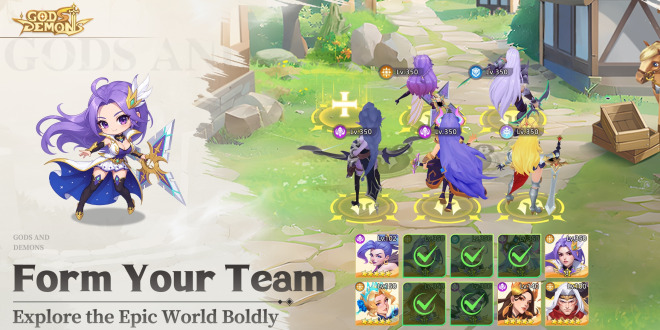
Gods and Demons blends accessible idle progression with a 6v6 turn-based competitive core that uses more than 60 heroes, plus customizable systems named Sacred Runes, Battle Seals and Aether Cores, and team-wide passive effects from Sacred Beasts. Xiao Han explained that idle mechanics supply routine resource gains and offline rewards so players can make substantial progress with short sessions — roughly half an hour during a commute or break — while the strategic layer is where meaningful decisions and team-building depth live. Individual battles are designed to last about three to five minutes and can be paused, and standard daily tasks are intended to take less than 30 minutes, with major limited-time events running seven to 14 days to give players flexibility in engagement. The team uses modes such as the Arena, the War God’s Temple and cross-server ranked competitions to emphasize tactical choices and team composition rather than the total time spent online, and PvE content like Sky Tower and Epic Monuments present different mechanical demands compared with PvP, ensuring different playstyles remain viable across modes.
On the design front, the studio focused on preventing a single dominant meta by combining three concrete levers: a roster exceeding 60 heroes, flexible itemised customisation, and varied encounters that require different tactical answers. Each hero carries four core skills but their battlefield roles can be shifted through Sacred Runes, Battle Seals and Aether Cores, and the influence of Sacred Beasts further changes how a hero functions across modes. Xiao Han noted that single-target burst damage is valuable for boss fights while coordinated crowd control plays a decisive role in ranked matches, and the Sacred Soul Altar lets players recover all resources spent on hero levelling with a single action to lower the cost of experimentation. That recovery mechanic was explicitly designed so players can try new heroes and team builds without permanently locking in their investment, making it easier to iterate on compositions across PvE and PvP challenges.
Community and social systems are structured to make individual progression meaningful to a group without turning social features into extra daily chores. The guild framework is built around shared rewards where members contribute to guild tasks and benefit from collective progress, and competitive guild modes such as the War God’s Domain and cross-server ranked competitions let groups compete together for shared standings. Xiao Han framed the social experience around cooperative achievement rather than solitary leaderboard play: guild members who help their group climb a cross-server tier share a concrete reward and a sense of belonging, which the studio treats as a central design objective for long-term engagement. The studio’s approach keeps guild obligations optional and outcome-focused, intending to make social contribution rewarding in a way that complements the game’s accessibility goals.
From a commercial and operational standpoint, Moye opted for multi‑store publishing from the outset to reach a broad audience across Europe and North America and to reduce dependence on any single storefront. Xiao Han said Google Play provides a foundation to validate the core experience and reach a wide audience, while AppGallery offers Huawei’s device ecosystem as a complementary growth channel — particularly in emerging markets where Huawei’s installed base provides additional discovery routes. The team sees AppGallery as lowering barriers to entry in regions that have been harder to reach through traditional storefronts, and notes that device profiles and spending patterns among AppGallery users matched the target audience for an accessible idle hero-collection game. Commercially, the publisher values having multiple distribution routes to diversify acquisition channels and to mitigate exposure to changes in individual store policies or revenue-sharing terms.
Technical and QA processes were organised around a single core codebase with platform-specific SDKs, automated build pipelines, and server-driven live content to reduce the need for simultaneous client approvals across stores. Xiao Han described three pillars of their release approach: a shared core codebase with decoupled account, payments and push-notification SDKs; an automated build and release pipeline that produces platform packages under unified versioning, with automated functional checks and performance profiling; and advance store submissions for client updates, while smaller balance adjustments and events are delivered through live updates where supported. Huawei-specific integration used HMS Core and GameCenter modular components for account, payment and push services, and Moye made use of AppGallery Connect (AGC) tools for crash analysis, cloud debugging and remote configuration. Huawei also provided hands-on engineering support including prompt technical responses, remote debugging sessions for complex crashes, and access to cloud testing on real devices, which Moye credits with reducing device compatibility testing time and cost for their team of 11 developers.
Early testing and metrics have directly shaped the team’s launch and monetisation plans. In an initial closed beta that was followed by a progress reset, 1,421 new players created characters in the first two days and day‑one retention reached 41.93%, surpassing the studio's internal 35% benchmark. Testing has focused on three principal areas: retention and churn points to refine early pacing and tutorials; player response to the monetisation mix, including monthly cards, growth funds, bundles and battle passes; and technical performance on lower-end Android hardware, with attention to heat generation and the readability of localized text. Those findings are feeding a phased strategy: Google Play is being used to refine the build and balance, monetisation pacing is being adjusted for expected iOS spending patterns, and AppGallery is being prepared as a channel to scale via Huawei’s device ecosystem once the core experience is validated.
Why it matters
Takeaway: Moye is prioritising engineering separation, platform-specific operating plans and AppGallery’s device-level reach to broaden distribution while keeping a small core team efficient — their closed beta numbers and Huawei’s hands‑on tooling support are the concrete building blocks shaping the staggered Google Play, App Store and AppGallery rollout.
Original source
PocketGamer.biz