

GTA 6 nears launch: full details after Aug 28 Netflix reveal
Key takeaways
- Netflix video released August 28 covering GTA 6 details
- GTA 6 map ~2x the size of GTA V (Vice City alone ~2x Los Santos)
- Main story length introduced as about 80 hours
- Over 170 animal species appear in the game
Rockstar Games' Grand Theft Auto VI (GTA 6) is now described as launching in roughly one month, and detailed information released after the August 28 Netflix broadcast lays out the game's protagonists, the open world they'll roam, and the criminal systems players will use. The two lead characters are Jason and Lucia, the open world—called the state of Leonida—runs roughly twice the size of GTA V's map, and Rockstar has flagged the story campaign at about 80 hours of playtime.
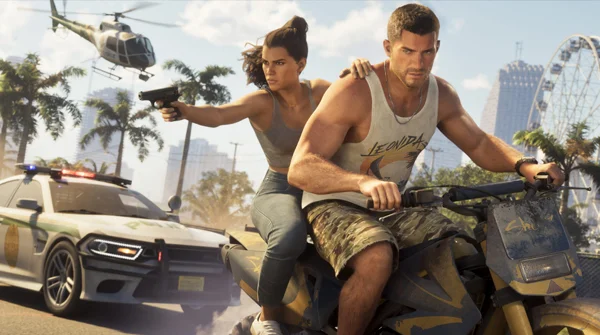
Jason and Lucia are the named protagonists of GTA 6, presented as a young, imperfect criminal couple whose relationship and actions drive the narrative. Jason is depicted as someone pushed into crime by circumstance; Lucia is an ex-con seeking a better life. The two characters form a dynamic partnership that the player can shape: their relationship can develop into romance through shared activities like gym workouts, zoo visits, kayaking, beach walks, and shopping, or remain a pragmatic criminal pairing. Direct interactions include holding hands or arm-in-arm walking, and characters exchange contextual messages—house-security reminders or bedtime notes—if the player chooses. Relationship choices carry gameplay consequences: abandoning a partner during a firefight can provoke anger and reduce partner cooperation or the success rate of robbery missions, while partners can independently threaten NPCs or hand weapons to each other during combat.
GTA 6's map is presented as the state of Leonida, a region with six core areas: Vice City, Leonida Keys, Grass Rivers, Port Gelhorn, Ambrosia, and Mount Carla National Park. Vice City serves as the dense urban center with Art Deco architecture and beaches; Leonida Keys takes cues from the Florida Keys; Grass Rivers is a wildlife-rich wetland; Port Gelhorn shows a decaying tourist area; Ambrosia is an industrial belt of factories and refineries with biker gang activity; Mount Carla focuses on natural landscapes. The full map is reported to be roughly twice the size of GTA V and three times the size of Red Dead Redemption 2, with Vice City alone said to be double the area of Los Santos. Players unlock full free-roam exploration after certain missions and can inspect structures via an in-game satellite 3D image in the pause menu to study building layouts and approaches. Interior access is extensive: hundreds of indoor spaces exist and buildings with helipads allow seamless vertical traversal to rooftop levels without loading screens via stairs or elevators.
Environmental simulation and living NPC populations are emphasized across the Leonida state. Weather is redesigned so cloud cover and storms move across the map, producing localized conditions where heavy rain can fall in one zone while an adjacent area stays sunny; extreme storms bring visible runoff from roofs and dynamic lightning. Animal life exceeds 170 species, including more than 60 bird species and over 30 land mammals, plus fish and reptiles; animal fur and pelt use a new system for more detailed rendering. Fishing is included as a collectible and challenge activity (fish cannot be taken home), while hunting provides money and resources. NPCs were developed after on-the-ground research in Miami and the Florida Keys; Rockstar engaged former police, gangs, and residents and staffed dedicated writers for NPC dialogue. NPCs now vary in height, build, and skin type, and will speak hundreds of contextual lines when standing on the street. NPCs also react to prolonged eavesdropping or being followed, becoming alert or aggressive if they detect suspicious behavior.
Physical realism extends into clothing, phones, vehicles, and daily routines. Characters leave footprints in sand; clothing and hair visibly wet after entering water; interior residents follow personal schedules and perform small actions like placing mugs or disposing of apple cores. In-world phones include parody apps similar to TikTok and Uber, and a vehicle-scanning app can show lock status, alarm and tracker presence, resale price, and registration fees. Vehicles require more realistic theft methods: early on players must jimmy door locks with improvised tools; later they can use a key-cloner obtained through story progression to copy electronic keys for newer cars. Stolen vehicles must be registered through payment to become permanently owned, and high-end cars may have GPS trackers requiring removal at a specific garage. Vehicle handling was tuned with input from real racing drivers to differentiate driving feel and tire behavior; cars need fuel and repairs at stations, and collision damage deforms parts and detaches pieces. Trunks can store large weapons, stolen loot, and even bodies. Weapon handling limits what characters carry: two pistols plus two long guns in total, with only one long gun worn on the back; additional long guns must be stashed in trunks or bases. Weapons visible in public will make NPCs keep distance, and pointing guns provokes screams, startling reactions, or armed countermeasures from those nearby. Recoil and weapon shock are increased to encourage short, controlled bursts; a non-lethal 'suppression shot' is included to intimidate or create escape opportunities. Violent physics include gore effects such as dismemberment in some shotgun impacts.
Law enforcement and wanted mechanics receive a full rebuild tied to witness reporting and detailed suspect descriptors. Crimes do not automatically trigger a wanted level if no one sees them; when reported, police use reported outfit, appearance, vehicle, and weapon details to pursue suspects. The mini-map radar does not show police positions during pursuits; players must use a 'Focus' function to identify pursuing units. Players can lower heat by discarding weapons, changing clothes and masks, and switching vehicles. Crime scenes are marked as red 'hit zones' on the map; reaching the top wanted level (6 stars) expands the hit zone across the entire map. Police employ aggressive tactics, including ramming vehicles and equipping trunks with shotguns, assault rifles, and body armor. Players can requisition weapons by looting police vehicles during engagements. Money plays a central progression role: story missions alone are insufficient to fund required spending, and the game can halt story progression until the player attains a needed cash threshold. Robberies and money-making activities include targeting convenience stores, gas stations, jewelers, banks, gang bases, cash vans, and loan businesses, with approaches ranging from stealthy back entrances and CCTV takedowns to code-cracking via found clues. Stolen goods, drugs, and jewels must be fenced for cash, which players can deposit in ATMs; consumables such as cocaine can be carried and used, and adult content including strip-club interactions and frequent drug depictions are plainly present.
GTA 6's campaign length is presented at roughly 80 hours, and story design reportedly encourages multiple playthroughs where small choices accumulate into large consequences. Players can shape Jason and Lucia's crime profiles across four defined types—Professional, Aggressive, Violent, and Psycho—based on in-game behavior. Avoiding unnecessary killing maintains a Professional profile, while repeated extreme actions can fracture the crime-profile icon and permanently lock certain profiles for that run. An in-game menu tracks character models, individual crime profiles, and relationship status so players can steer each aspect independently. The game includes broad leisure options—shopping, fishing, hunting, zoo visits, kayaking, mini-golf, and scuba diving—and a variety of radio and broadcast channels spanning classic rock, modern hip-hop, pop, and talk radio.
Why it matters
Takeaway: GTA 6 pairs roughly 80 hours of story with a state-sized map about twice GTA V's area, a heat-and-witness-based police system, and money gates that can halt story progression until players raise funds—so expect story beats and criminal freedom to be tightly interwoven with in-world economics and persistent character choices, whether you cultivate Jason and Lucia as partners in romance or criminal efficiency.
Original source
Google News: GameMeca