

Asia and MENA Video Game Revenue to Exceed $100 Billion by 2030
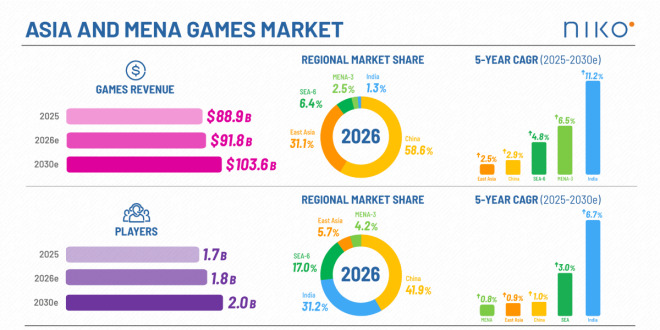
According to a recent report from Niko Partners, video game revenue in Asia and the MENA regions is on track to surpass $100 billion by 2030. The combined revenue reached $88.9 billion in 2025, marking an increase of nearly 3% year-on-year. This growth trajectory is expected to continue, with projections indicating revenue will rise to $91.8 billion in 2026 and ultimately reach $103.6 billion by 2030, reflecting a five-year compound annual growth rate (CAGR) of 3%.
India is emerging as the fastest-growing market, boasting over 500 million players and an impressive 11% CAGR, with mobile player spending anticipated to exceed $1 billion by 2027. While established markets like China, Japan, and Korea are projected to account for 89% of total revenue by 2030—estimated at $91.7 billion—the most significant growth is occurring in India, MENA, and Southeast Asia.
The MENA-3 countries, which include Saudi Arabia, the UAE, and Egypt, are projected to reach $3 billion in player spending by 2030, making them the second fastest-growing region after India. Southeast Asia is also showing promise, with Thailand forecasted to hit the $2 billion mark in 2026 and Indonesia expected to reach $1.5 billion by 2030. Additionally, Vietnam is set to grow its player base to 68 million by 2030, while Indonesia is projected to reach 144 million players.
Furthermore, China's mini games now account for nearly 20% of mobile game spending. The increase in India's mobile player spending is being driven by genre diversification beyond traditional battle royale games. Notably, female players now represent 42% of the player base across Asia and MENA, a rise from approximately 40% in the previous year, shifting from an 80% male demographic five years ago.
Why it matters
In terms of technological advancements, Niko Partners noted that player sentiment toward generative AI in Asia is significantly more favorable than in Western markets. Game studios are reporting development efficiencies due to AI, although players prefer AI to assist workflows rather than replace core art or marketing assets. The full report can be accessed through the provided link.
Original source
PocketGamer.biz